


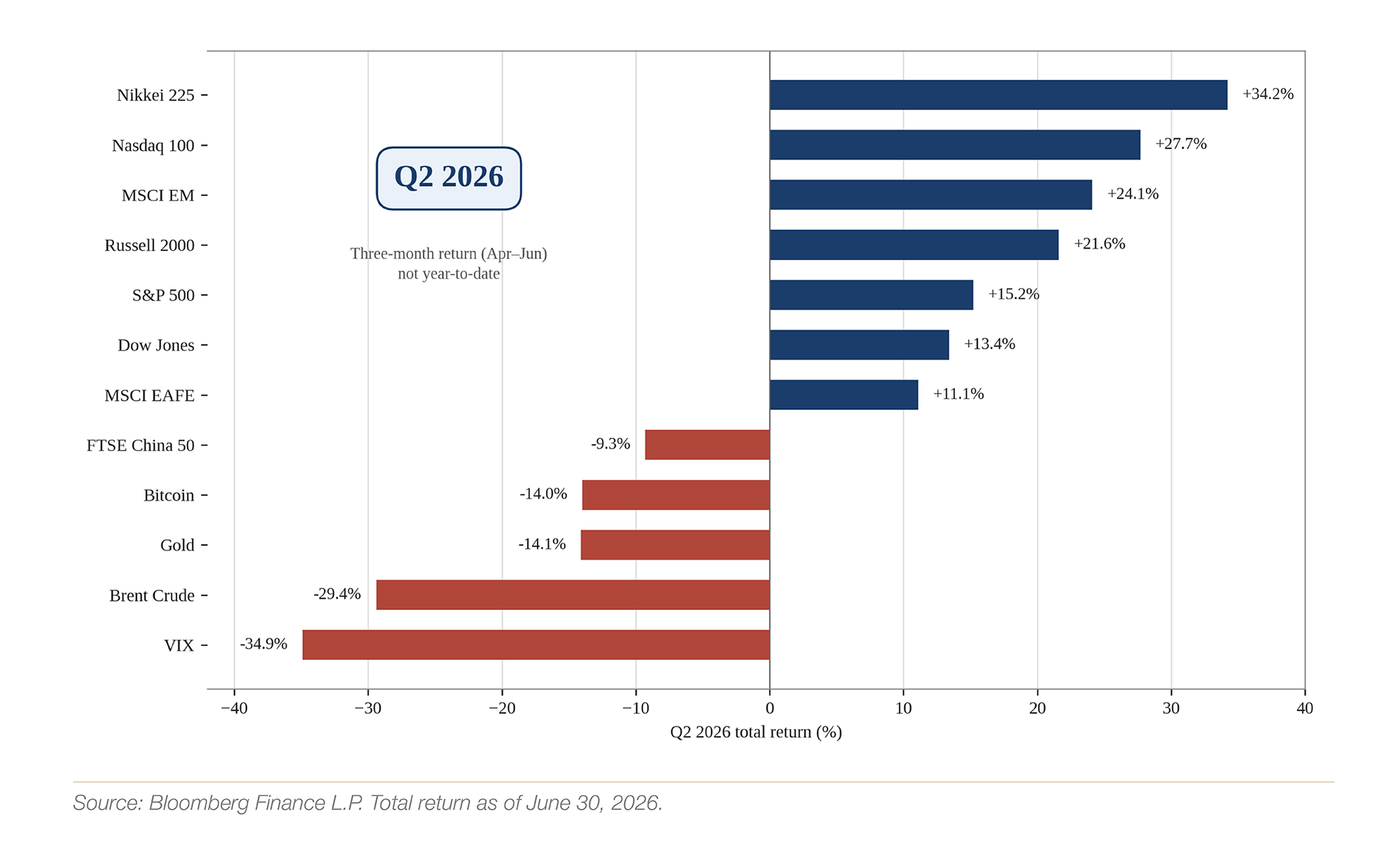
Markets spent the second quarter erasing much of the anxiety from the first. Oil prices retreated, volatility subsided, earnings remained strong, and investors returned to companies and themes most closely tied to artificial intelligence. The S&P 500 gained 15.2%, the Nasdaq 100 rose 27.7%, and the Russell 2000 advanced 21.6%, putting each major index back in positive territory for the year. The rebound restored confidence, but it did not provide a clean macroeconomic all-clear.
The U.S. economy is not in recession, and we see little evidence that one is imminent. Labor markets remain resilient, business activity is expanding, and credit conditions show no broad stress. Yet growth is increasingly uneven. AI-related capital spending and large-cap technology earnings continue to support the expansion, while housing, lower-income consumers, small businesses, and other rate-sensitive sectors remain under pressure. Inflation is similarly divided, with energy and select services sustaining headline pressure even as home price growth, autos, and core goods cool.
The result is a more stable outlook, but also a smaller margin for disappointment. Equity valuations are again demanding, and expectations for AI-related investment and earnings leave little room for weak execution. Conflict in the Middle East has de-escalated but remains unresolved, leaving inflation vulnerable to another energy shock. Meanwhile, the Federal Reserve, now under Chair Kevin Warsh, appears less inclined to provide near-term support than markets had anticipated.
This is the central tension heading into the second half of the year. Markets have priced in a recovery, but the path ahead hinges on several fragile assumptions: oil must remain contained, AI earnings must continue to justify extraordinary capital spending, inflation must moderate without prompting further tightening, and the Fed must avoid overcorrecting. That outcome is possible, but the strength of the second-quarter returns should not obscure how little room remains for error.
Q2 2026 Market Snapshot: Strong Returns, Reduced Margin of Safety
Since 1970, a quarter this strong for the S&P 500 has happened only once every five years on average, which is itself a useful gauge of how far sentiment swung. International markets moved with the same force: Japan surged 34.2%, emerging markets gained 24.1%, and developed international (EAFE) rose 11.1%. China was the exception, with the FTSE China 50 down 9.3% for the quarter and now off nearly 17% year to date.
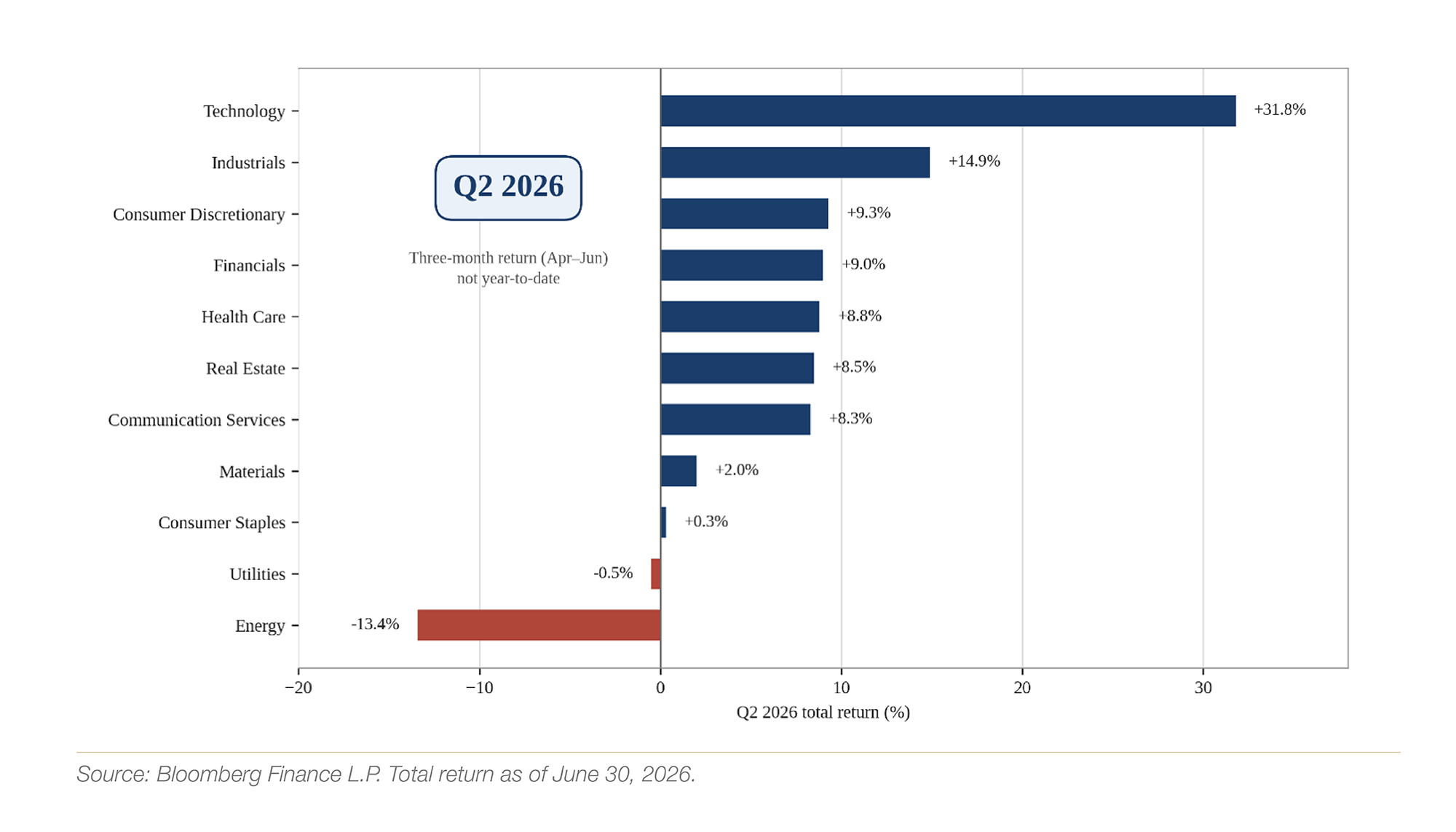
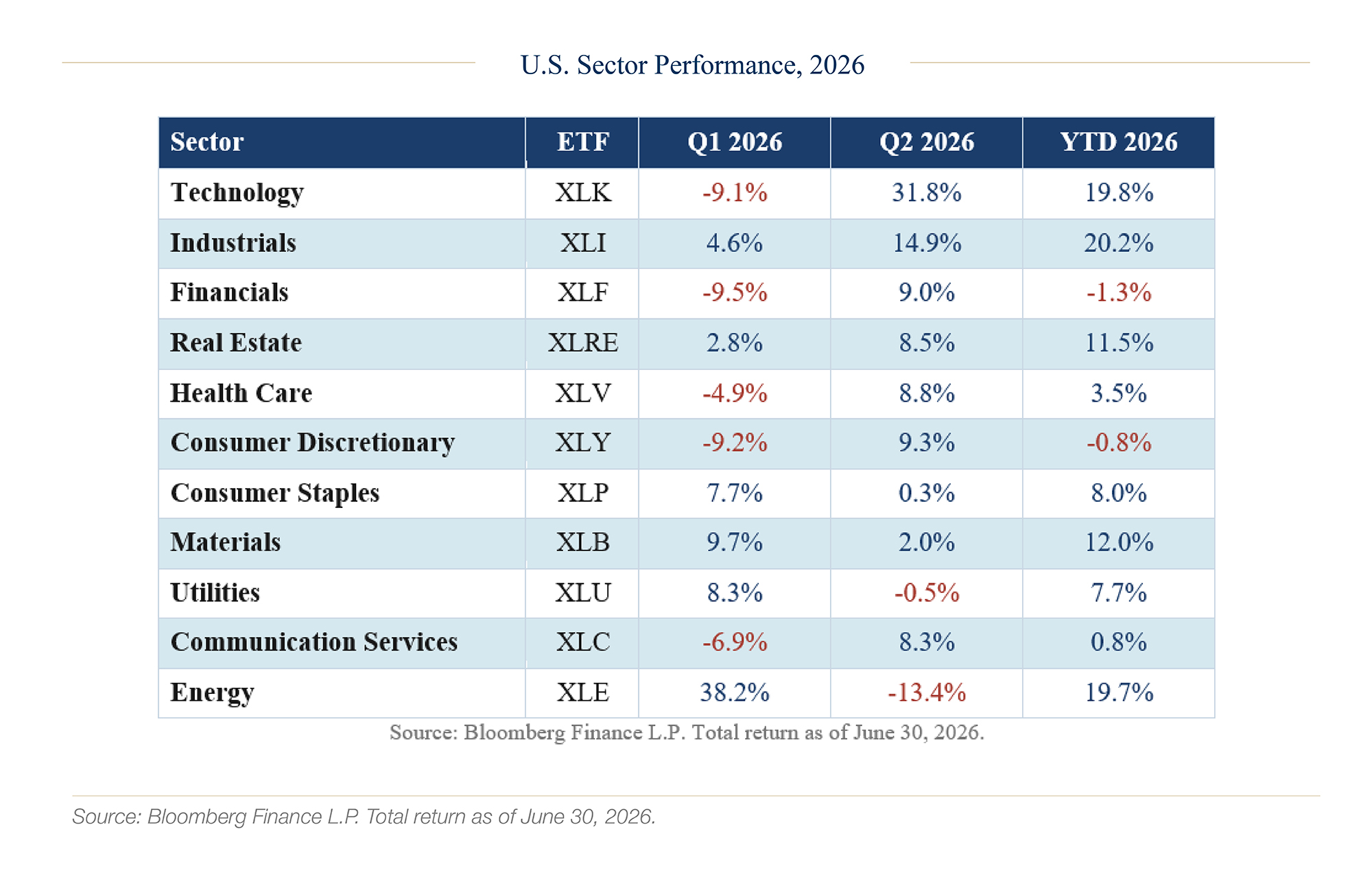
The sector rotation was the sharpest part of the story. Energy, Q1’s dominant winner as oil spiked, gave back 13.4% as crude retreated, while Technology surged 31.8% and led broad-based gains across Industrials, Consumer Discretionary, Financials, Health Care, Real Estate, and Communication Services, each up 8% to 15%.
The cross-asset picture reinforced the same message. Brent crude fell 29.4% as supply conditions improved and markets priced in a lower probability of sustained disruption in the Strait of Hormuz. The VIX declined 34.9%, reflecting a major compression in volatility from the first-quarter shock.
The S&P 500 and the Dow ended the first half of the year up around 10%, with the Nasdaq 100 and the Russell 2000 both up over 20%. Emerging markets, Europe, and Japan were all strong, while U.S. Municipal Bonds and Corporates held up nicely. Losers for the quarter were Chinese equities, Gold, and Bitcoin.
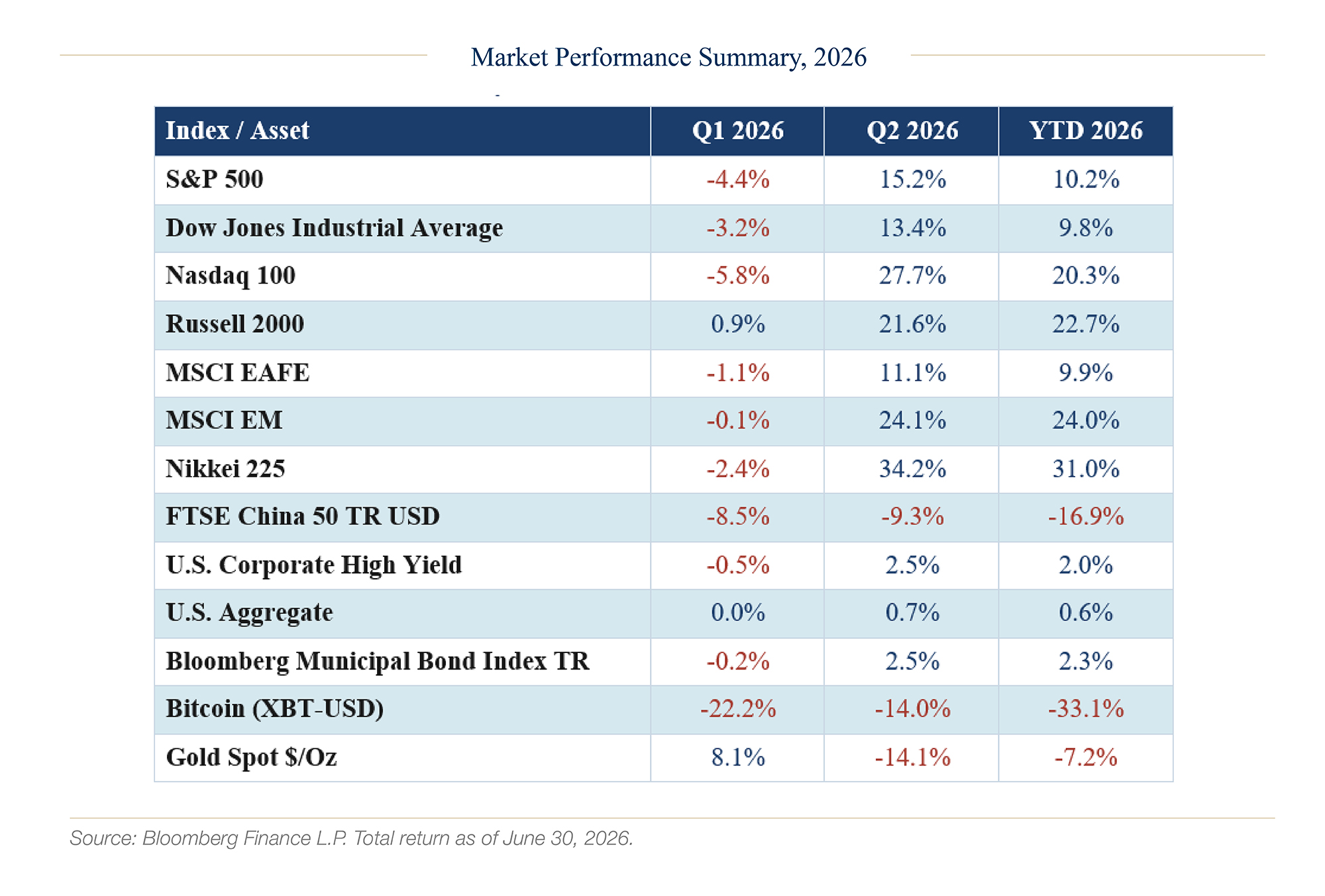
The magnitude of the rebound matters, but so does its composition. This was not a broad all-clear: the strongest gains came from areas most levered to AI and the energy-shock reversal. Technology’s 31.8% quarterly gain and Nasdaq’s 27.7% gain reflect genuine earnings strength but also leave valuations and expectations more stretched. The quarter rewarded risk-taking, but it also reduced the margin of safety.
The U.S. sector table (below) illustrates the magnitude of the reversal.
The Macro Backdrop: Stabilization, Not Normalization
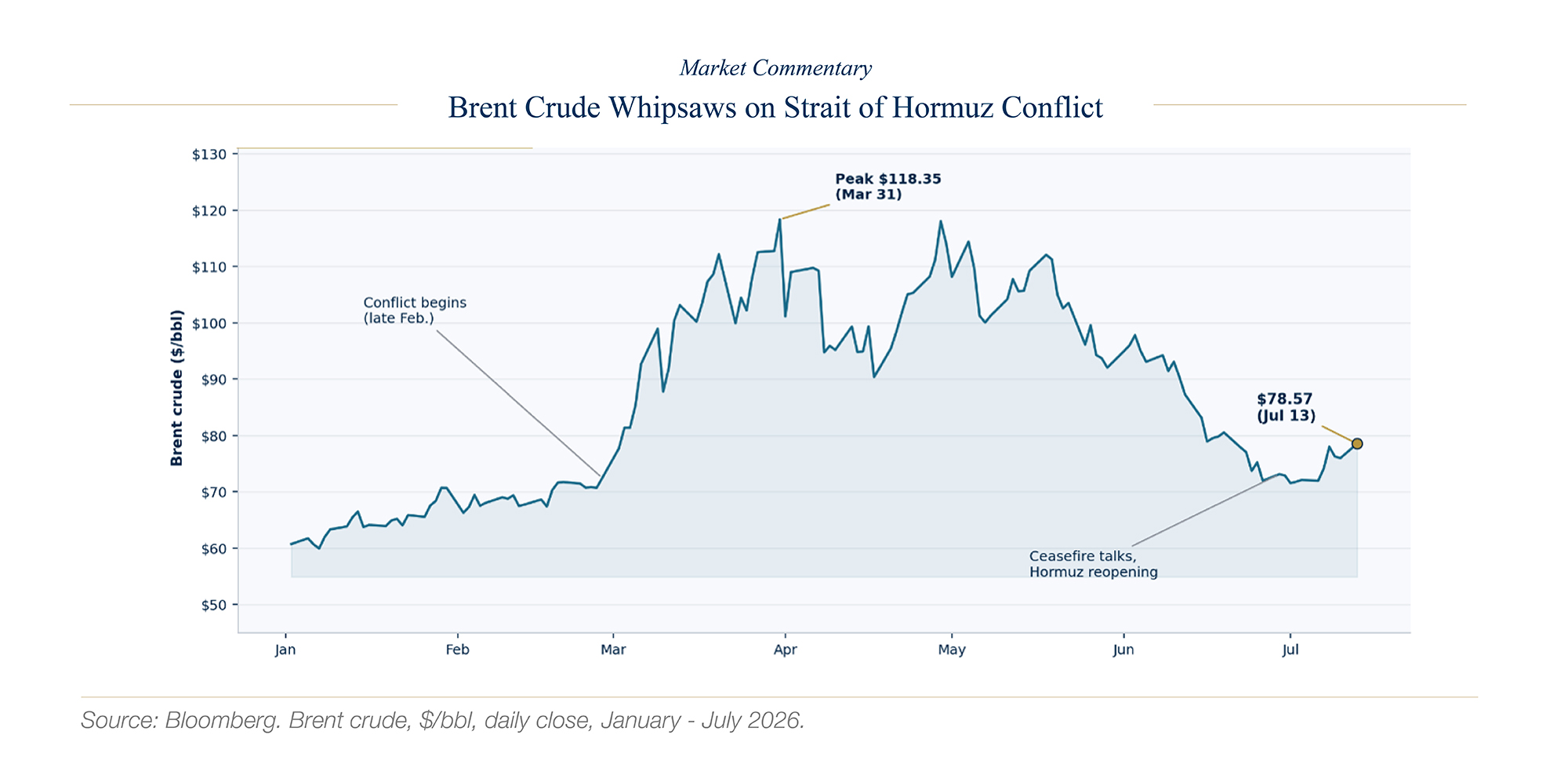
Almost immediately after the first quarter ended, ceasefire talks began dominating the headlines, coinciding with a peak in oil prices and a temporary bottom in equity markets. Yet the conflict’s consequences had only begun to filter into consumer prices and inflation expectations, while also constraining the Fed’s ability to deliver future rate cuts.
From that point forward, oil remained the central transmission channel through which negotiation headlines drove volatility and daily market moves. And despite crude’s round-trip from about $70 to a peak of $120 and back during the quarter, markets discounted this improvement much faster than the economy and consumers could. We were pleased that the negotiated U.S.-Iran memorandum had a positive impact on immediate oil supply fears, but see little clarity on how a broader ceasefire resolution and agreement on the go-forward regulation of Hormuz traffic will ultimately be resolved. For the time being, market reactions have calmed amid the flip-flopping of fortunes in the Middle East, but the fuse remains lit, and sparks could fly at a moment’s notice.
U.S. Growth: Resilient in Aggregate, Uneven Beneath the Surface
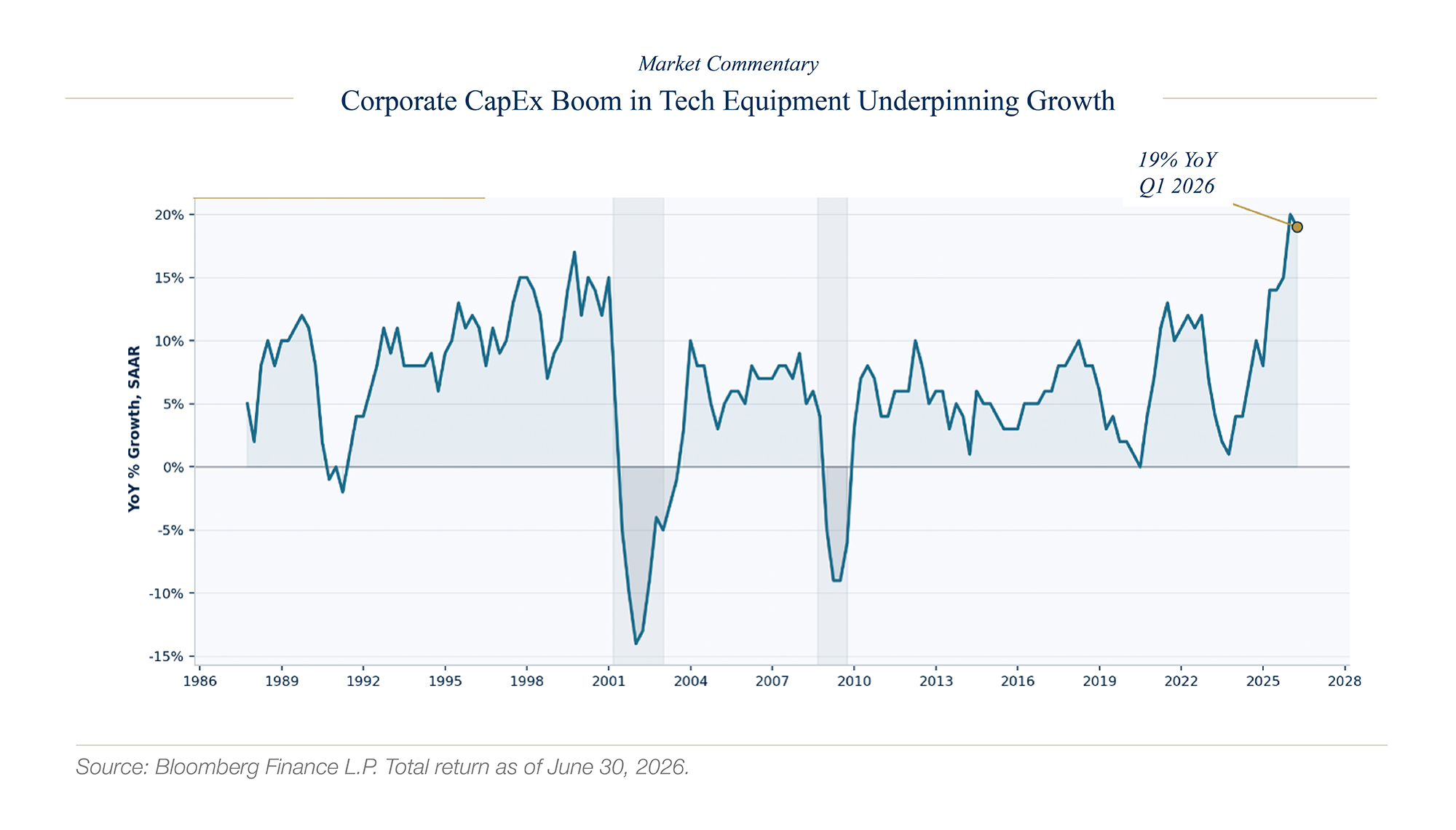
The K-shaped economic recovery that has defined the dichotomy between lower income and higher income consumers has now extended to U.S. corporates following the passage of the One Big Beautiful Bill in 2025. The initial boost to consumers, in the form of increased standardized deductions and no tax on tips, has waned amid higher gasoline prices, rents, insurance costs, and interest rates. But the powerful combination of permanent and immediate deduction of R&D expenses, which accelerates corporate spending and earnings growth, and the resulting wealth and income effects for high-income households has been significant. Together, these forces have shifted the balance of growth contributions from consumers toward corporations thus far in 2026. To wit, many ISM measures, most notably manufacturing PMIs, have climbed to their strongest levels since 2022, and the growth in fixed investment by U.S. corporates in tech-related processing equipment & software is now stronger than it was in the late 1990s Tech Boom.
Still, late-quarter data on the U.S. consumer argued against an overly bearish view. Payroll growth beat expectations in April and May, unemployment held around 4.3%, and layoffs remained below recessionary levels, while May retail sales rose 6.9% year over year (0.9% MoM), with strength beyond gasoline suggesting aggregate demand remained firmer than sentiment surveys implied.
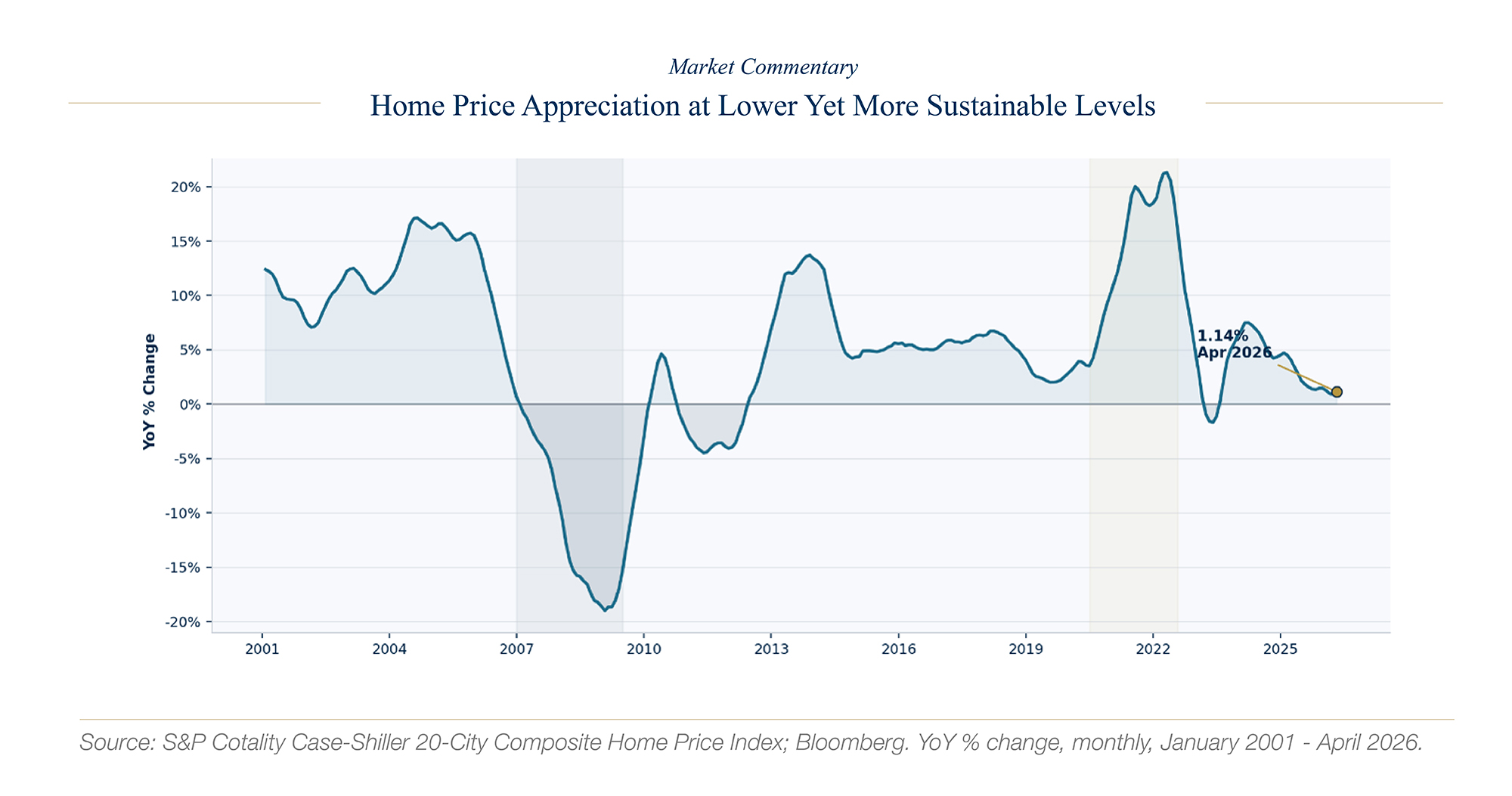
Housing remains one of the clearest examples of restrictive rates biting beneath the surface. Mortgage rates stayed in the mid-to-high 6% range, applications weakened, and housing starts fell sharply at points in the quarter. The Case-Shiller 20-City index rose just 1.1% year over year in April, up modestly from March’s 0.8% but still among the weakest readings since 2023, a dramatic contrast to the post-pandemic boom.
We believe the deeper point is that the economy is increasingly split between areas supported by AI investment and high-income consumers, and areas pressured by high financing costs and elevated prices. That split is why aggregate data can look resilient while living conditions feel strained. The expansion is intact, but uneven.
The Fed: Warsh, Discipline, and a Higher Bar for Support
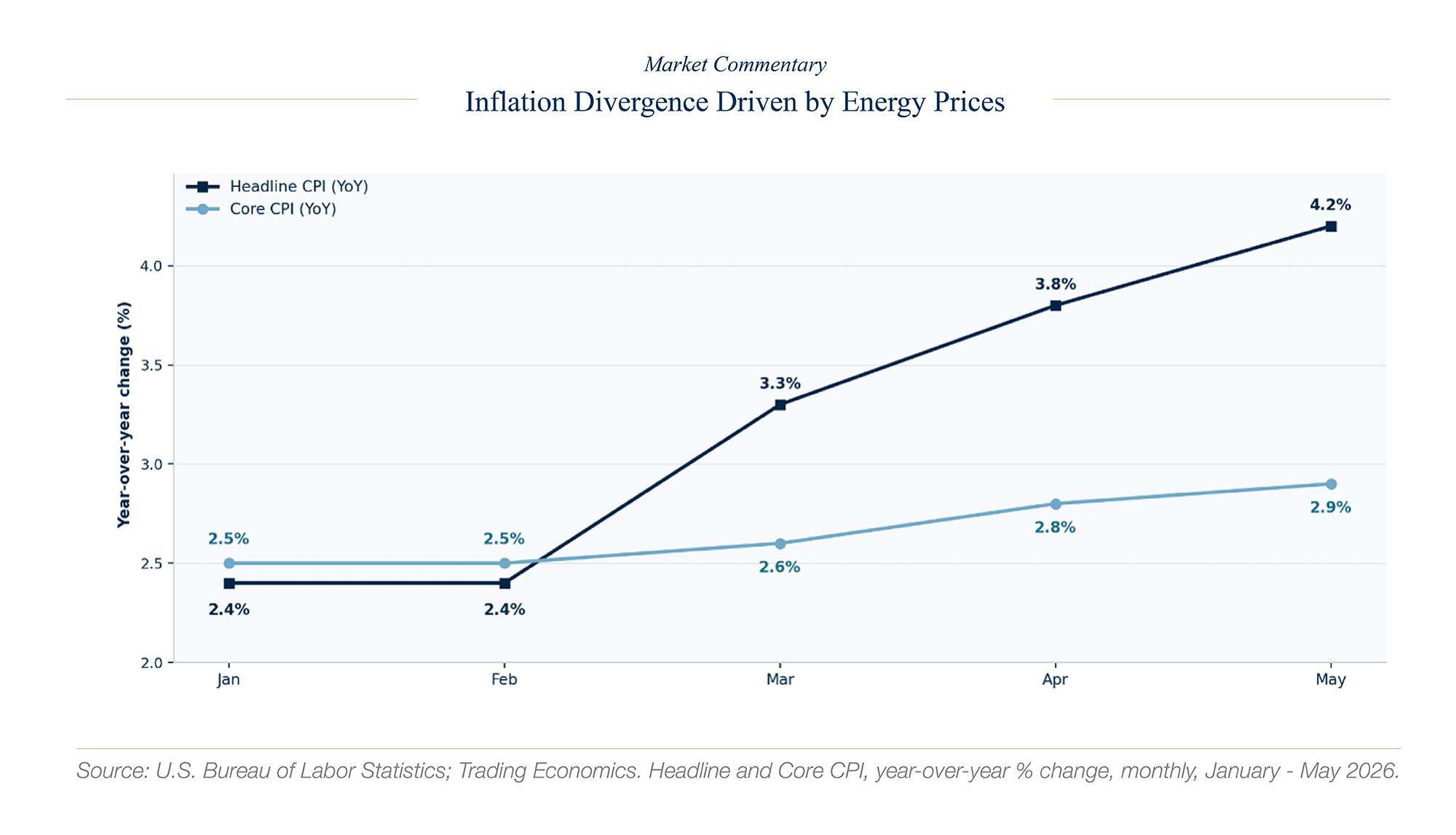
The Fed policy backdrop has grown more complex since the start of the Middle East conflict, as oil prices have risen and uncertainty has grown. Headline CPI rose to 4.2% year over year in May, the highest since early 2023, but the acceleration was driven disproportionately by energy, which rose 23.5% year over year on the Middle East shock. That is a vastly different problem than a broad, synchronized reflation. The April FOMC meeting revealed real internal division, and as headline inflation reaccelerated, rate-cut expectations faded toward a higher-for-longer path.
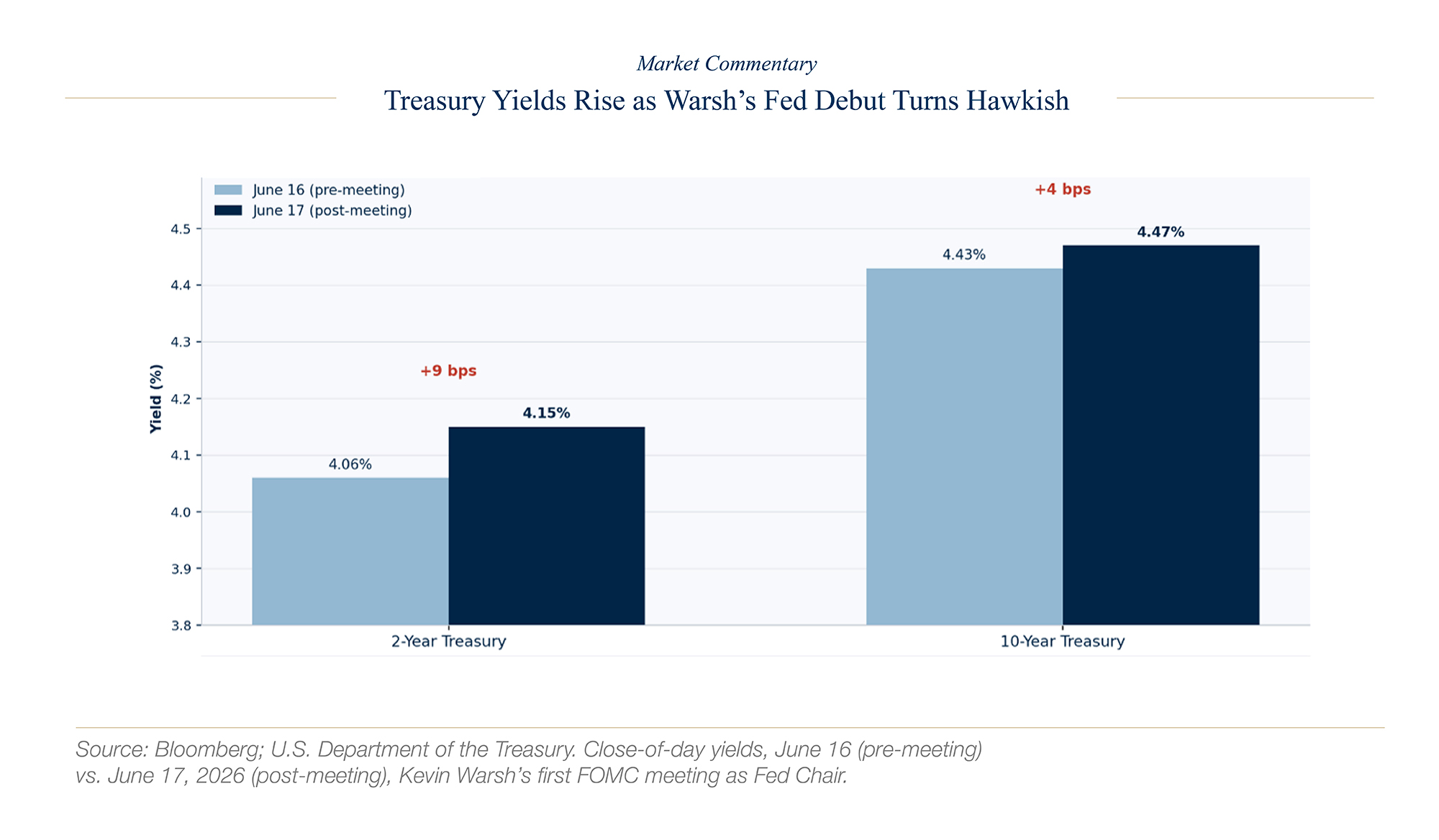
The transition to Kevin Warsh as Fed Chair added another layer of uncertainty. His first press conference on June 17 was measured in tone, but markets heard a hawkish message. The Fed held rates at 3.50% to 3.75%, but removed its easing bias, the Summary of Economic Projections shifted higher, and nine of eighteen participants projected at least one hike this year. Warsh emphasized price stability and reduced reliance on forward guidance without offering his own near-term policy bias.
The yield curve reaction underscored the nuance: 2-year yields rose, while the long end remained flatter, consistent with markets hearing near-term discipline paired with a longer-term growth drag rather than a generalized inflation scare. Warsh did not need to sound aggressive to shift the market’s read; by emphasizing price stability and stepping back from forward guidance, he may have effectively signaled the Fed is in no rush to provide relief. Importantly, it does not mean he is in a rush to raise rates either.
As evidence, we would note that at his April 21 confirmation hearing, Warsh argued that headline and core PCE offer only a “rough swag,” shorthand for a scientific wild guess, on the true state of underlying prices. He identified the “trimmed mean PCE” as his preferred measure because it strips out the most extreme monthly price moves before averaging, with the goal of isolating whether price changes are having “second-order effects on the economy.”
The distinction is not academic. The Dallas Fed’s trimmed mean PCE has held within a narrow 2.3% to 2.4% range from February through May, even as core PCE excluding food and energy climbed from 3.0% to 3.4%, a gap that has widened from 0.7 to a full percentage point. Under Warsh’s lens, underlying inflation still looks close to target; under the Fed’s traditional measure, it does not.
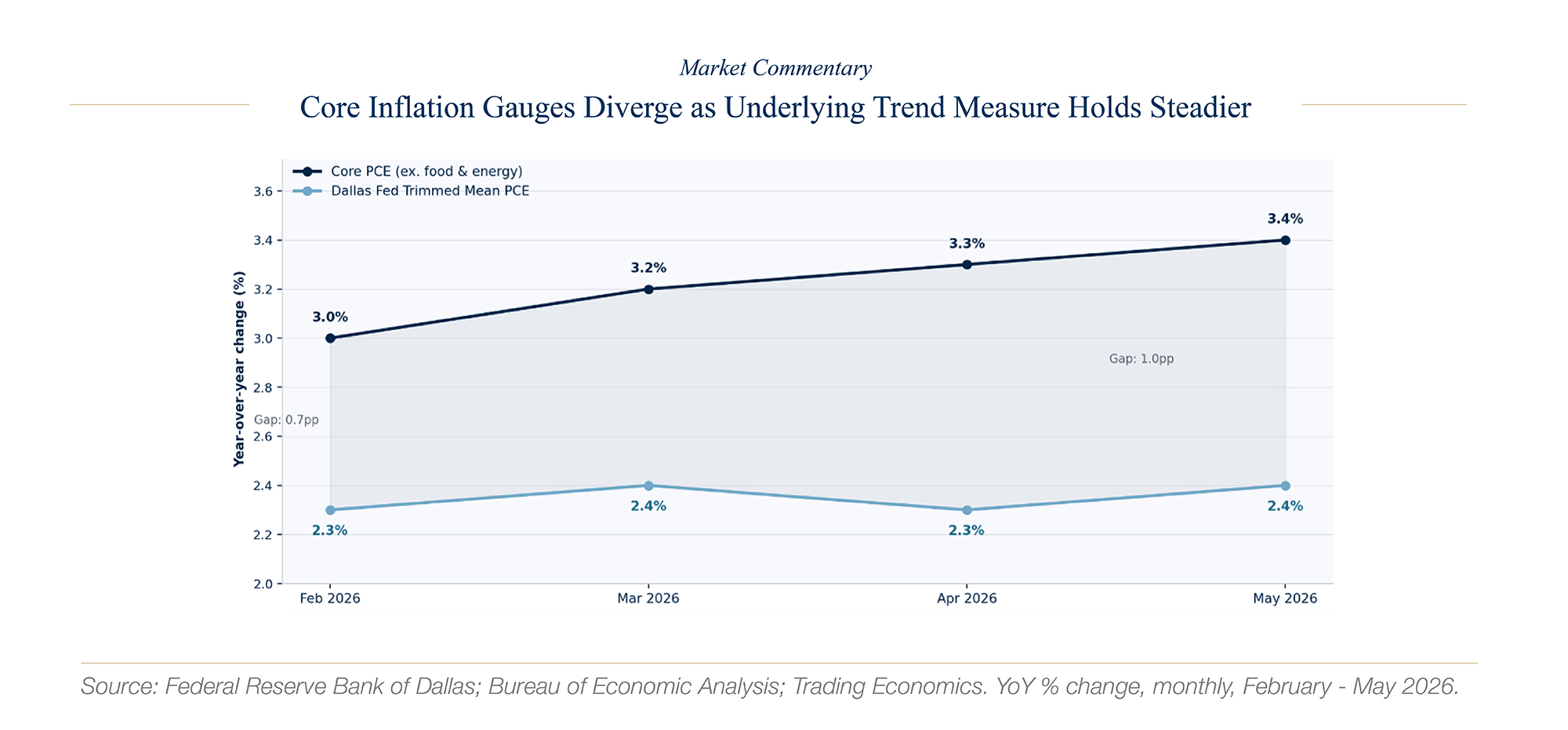
We think this divergence deserves close attention. If it reflects transitory tariff- and energy-driven spikes, Warsh’s framework may prove the better guide; but the Dallas Fed’s own researchers caution that when price changes skew unusually wide, as they have recently, the trimmed mean can understate persistent pressure. We are sympathetic to Warsh’s instinct to look through one-off shocks, and we plan to track the trimmed mean alongside core PCE more closely from here, since the gap between the two may be one of the better real-time signals of Fed patience and rate-cut timing.
The Fed’s problem is not that growth is too weak, but that it remains firm enough to keep inflation concerns alive while energy-driven inflation limits room to respond if growth weakens later. The Fed “put” is further out of the money than markets had hoped, leaving risk assets vulnerable to growth shocks, while upside inflation surprises threaten to eliminate the policy backstop entirely.
AI, Earnings, and the Risk of Extrapolation
For now, corporate earnings growth, particularly in technology and AI-linked segments, remains in the driver’s seat and in the exuberant expectations of investors. Hyperscaler capital spending, semiconductor demand, and data-center infrastructure needs continue to support business investment and market leadership, and several firms are showing AI spending translates into real revenue and earnings power. This is not simply a bubble narrative.
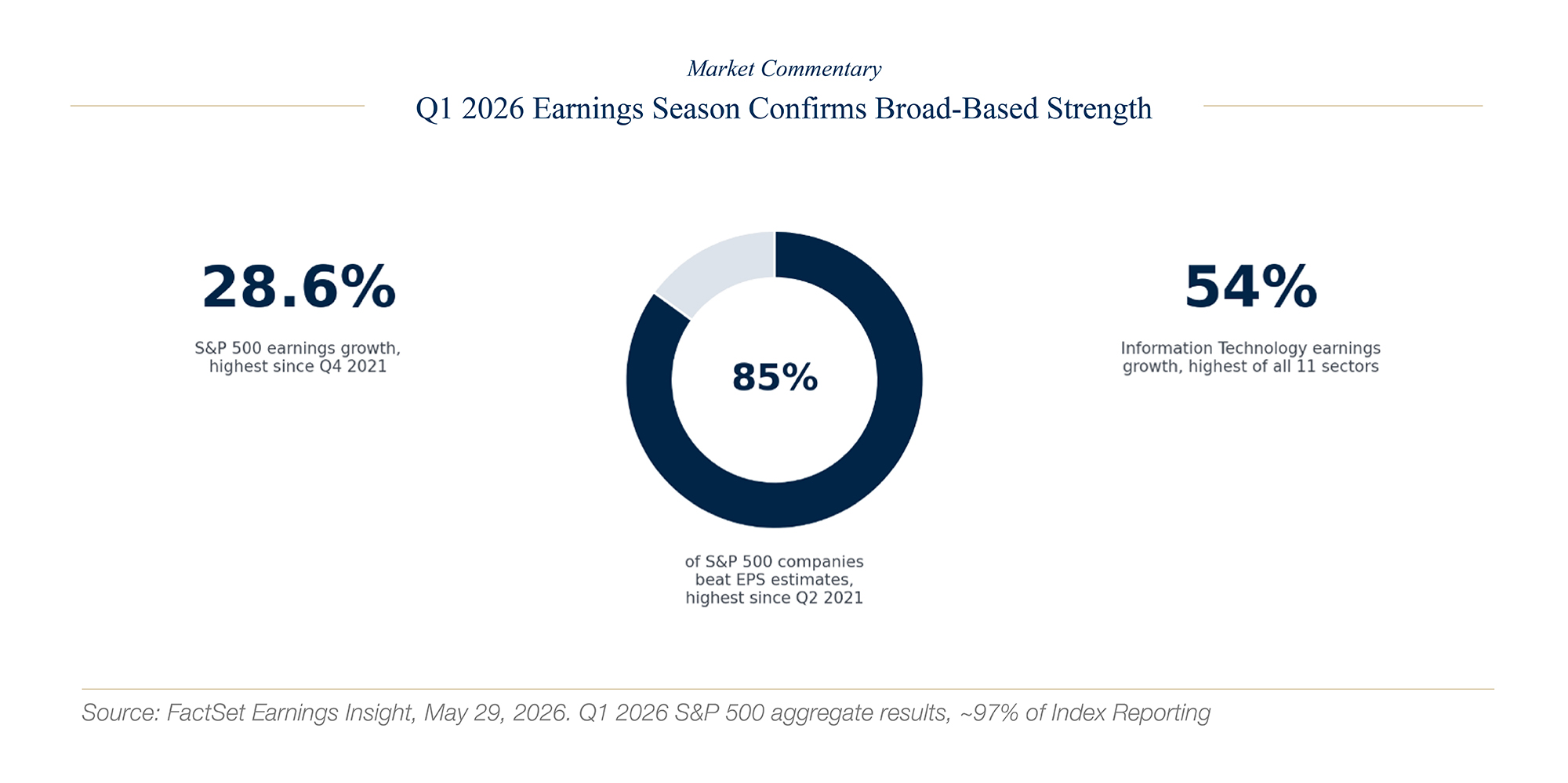
But we observe that most major investment cycles behind a genuine technological discontinuity, from railroads to fiber optic cable, have also been those most prone to overbuilding ahead of demand. The risk here isn’t that AI is fake. It’s that the market is extrapolating today’s growth rate too far into the future and paying premium multiples for cash flows that already assume near-flawless execution.
The encouraging sign is that investors appear to be growing more discerning: strong earnings alone are no longer sufficient for companies with the largest capital commitments. Those linking AI spending to durable margins and cash flow growth should stay well positioned. Those asking investors to underwrite open-ended spending on faith may face a harder environment from here.
The first phase of the AI cycle rewarded exposure. The next phase may punish weak underwriting. We do not want to abandon exposure to one of the most powerful investment cycles in the economy, but we also will not pay any price for distant cash flows.
This also explains why the broader expansion feels narrow: AI-related capital spending can lift GDP, earnings, business investment, and market leadership without improving conditions for the median household or small business. It is not a uniformly strong economy, but one where a powerful investment cycle is masking weakness elsewhere.
Fixed Income and Credit: Income Is Back, But Spread Beta Is Less Attractive
Fixed income became more attractive during the quarter, though not because the environment calls for a large directional duration bet. Nominal and real yields are high enough to provide meaningful income and cushion, particularly for long-term investors, liability matchers, and investors willing to be patient. This is a materially different environment from the post-COVID period, when bonds offered limited income and limited margin of safety. The opportunity is to earn income while waiting, not to make an oversized call that rates will collapse. Duration can help if growth weakens and inflation moderates, but the Fed’s near-term hawkishness and the risk of renewed energy pressure argue against treating duration as a one-way trade. The path of inflation still matters, and the Fed has not yet regained the flexibility it may have had at the start of the year.
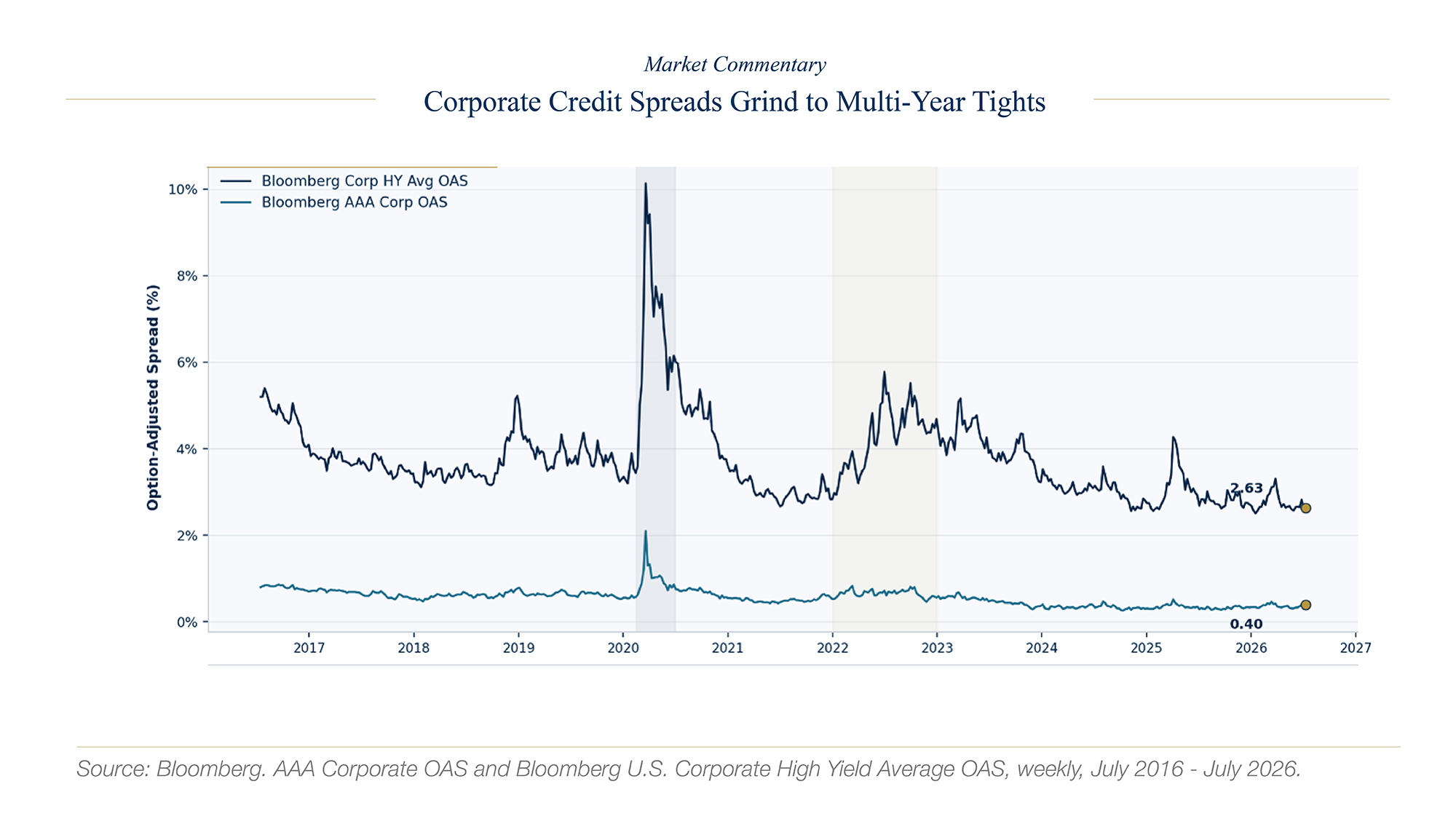
We see credit as more complicated. Spreads moved back toward historically tight levels, and while the credit system shows no broad stress, these spreads leave a lower margin for error. The better opportunity is selective income: securitized assets, structured and customized credit, high-quality carry, volatility premium, and global fixed income opportunities beyond the narrow U.S. Aggregate universe. Investors should be compensated for complexity, structure, collateral, liquidity, or manager skill, and should be more cautious about owning broad spread beta at tight compensation levels.
Quality, Valuation, and Portfolio Implications
Our conclusion is not to step back from risk assets but to raise the bar for what earns a place in the portfolio. Equities have already priced in a good deal of stabilization, continued AI earnings growth, and policy patience, which makes broad market exposure less compelling today than it was after the first-quarter drawdown.
We continue to favor businesses with strong balance sheets, pricing power, and cash generation that does not depend on capital markets staying euphoric or the Fed turning accommodative. The more uncertain the macro backdrop, the more it is worth owning companies that can compound on their own terms rather than needing the environment to cooperate.
For equities specifically, our preference is to stay invested but with a lower tolerance for weak underwriting. We are wary of AI narratives that lean more on capital spending than on monetization. We will seek to favor visible earnings durability and return on invested capital over a good story.
Looking Ahead
The market has already answered one question: Investors were right to look beyond the first quarter’s shock. The harder question is how to invest after the rebound has restored confidence, pushed valuations higher, and lowered the prospective reward for taking risk. With much of the recovery now reflected in prices, we believe the second half is likely to reward judgment and discipline more than broad exposure.
The risks remain unresolved. Renewed instability around the Strait of Hormuz could revive energy and inflation pressures. Valuations of AI-linked companies remain elevated, and tensions surrounding trade, fiscal policy, and Federal Reserve independence continue to cloud the outlook. In our review, these risks do not necessarily signal the end of the expansion, but they do raise the cost of weak underwriting and leave portfolios more exposed to disappointment.
For us, the answer is not retreat but selectivity. We believe investors should remain invested, favoring durable cash flows, demanding adequate compensation for complexity and credit risk, collecting income where available, and preserving the flexibility to act as conditions change. The economy remains resilient enough to extend the expansion, but not balanced enough to make the path easy.
In this environment, patience is not inactivity. It is a source of optionality.
Disclosure
A&M Private Wealth Partners, LLC (“AMPWP”) is an SEC-registered investment adviser. SEC registration does not imply a certain level of skill or training. For additional information on the services AMPWP provides, as well as our fees for such services, please review our Form ADV at adviserinfo.sec.gov, contact us at 300 Banyan Boulevard, 10th Floor, West Palm Beach, FL 33401, or call us at (561) 268-0900.
This piece and its content reflect AMPWP’s views at the time of its writing, and the information presented and AMPWP’s views are for informational purposes only. Such views are subject to change at any time without notice including due to changes in market or economic conditions, and forward-looking statements or forecasts are based on assumptions and may not be realized. Future events and outcomes are inherently uncertain. Statements are subject to risks and uncertainties that could cause actual outcomes to differ. AMPWP has obtained information provided herein from various third-party sources believed to be reliable, however, such information is not guaranteed and is subject to errors, omissions, and changes. No reliance should be placed on the views and information presented when making any investment or liquidation decision. AMPWP is not responsible for the consequences of any decisions or actions taken or not taken as a result of the views and information presented, and AMPWP does not warrant or guarantee the accuracy or completeness of this piece or information presented.
Additional content may be relevant for further context or other insight. Portfolios should also be viewed in the context of the broad market and general economic conditions prevailing during the periods covered by performance and other information. Any references to future returns and/or risk are not promises of the actual return a portfolio may achieve nor do they reflect all risks. Not all investments are suitable for all investors. All investments involve risk of loss, including to principal, and all investors must be prepared to bear such loss. Different securities, strategies, and allocations have different costs and risks, and diversification also does not assure a profit nor protect against a loss. Past performance is not a guarantee of future results. Additionally, changes in investment strategies, contributions, or withdrawals may materially alter results, as may market conditions, other factors including but not limited to economic factors, fees, expenses, and events. Nothing herein should be construed as an investment recommendation. AMPWP does not provide legal, accounting, or tax advice, and AMPWP’s services are not intended to act as a substitute for such advice. AMPWP encourages you to seek the counsel of a qualified attorney and/or accountant for legal, accounting, or tax advice.